Showing posts with label Ink. Show all posts

Monday, December 9, 2013

Guild Mirandola's Oak Gall Ink Kit

Or, Isabel and Aife have a playdate.

At one of the recent SCA events I attended there was an auction and one of the items was a bag full of scribal goodies. Of course I had to have that baggie, but if truth be told I feel a little guilty for paying so little for goods worth A LOT more. One of the items in the baggie was an Oak Gall Ink Kit from Guild Mirandola, a small scribal supplies vendor here in the East Kingdom.

Aife needed ink for something she's working on, and I just happened to have the supplies available. What follows isn't my own work, it's what happened when we followed the instructions included in the Kit. I'm not going to specifically detail the instructions and ingredients here as I feel that would be unfair to Guild Mirandola (Doscelina's contact information can be found on the website). The Kit contains very easy to follow instructions and I strongly recommend that people buy the Kit. This is period-style ink making made so simple that ANYONE can do it.


Although the Oak Gall Ink Kit contains exactly the about of ingredients you need, we actually ended up making double what was specified because I had my own supplies already but had never actually gotten around to using them. Other items needed are easy to lay your hands on and should be readily available to most people.

Crushed gall nuts in the mortar.
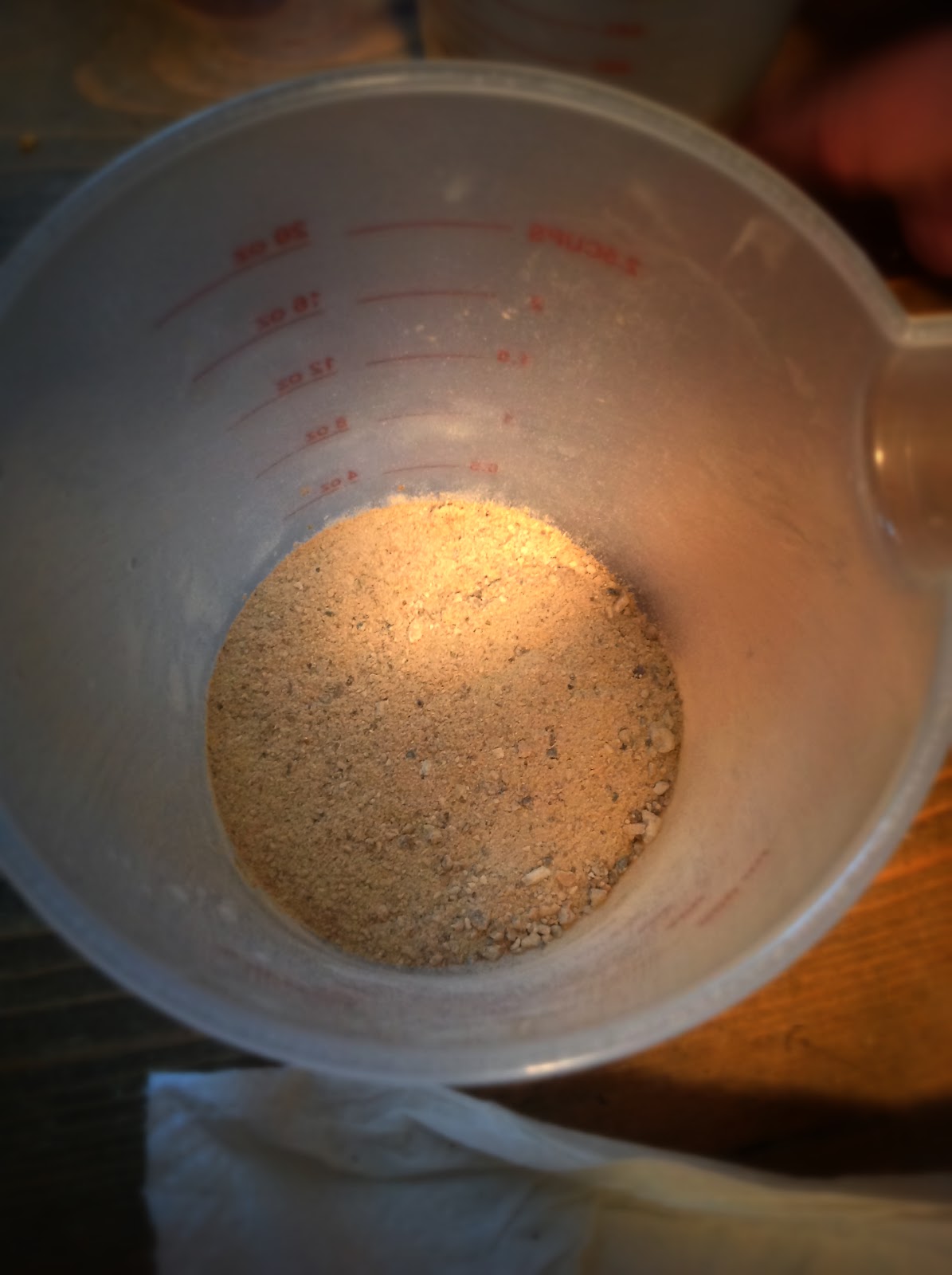
First order of business was to set up the gum arabic crystals to dissolve while we followed the rest of the instructions. Once that was set up we needed to crush the gall nuts. They were shoved into a plastic ziplock bag, that was then wrapped in a kitchen towel and then smashed vigorously with a hammer borrowed from my "shop gnome". Once they'd been reduce to much smaller pieces they were transferred to the mortar and pestle and ground into "a fine powder".

I do want to comment on how annoying these were to grind, they proved to be much tougher than I had imagined. They are surprisingly hard and I actually ended up with a blister in the center of my hand from the grinding. Get around this by getting them as broken and small as you possibly can with the hammer. The smaller they are before they hit the mortar and pestle, the less hand grinding you'll need to do.

You'll end up with this...

Gall nuts reduced to "fine powder"
Continuing to following the instructions, add the water and let it sit. So just how patient are you? We were working on a couple of other projects at the same time, so our little container of brown gunk actually ended up marinating for well over an hour. It has a VERY earthy smell which I surprisingly found quite pleasant.

Back to following the instructions that came with the kit and we find that it's time to add the green ferrous sulfate. The instructions say that when you add this to the brown gunk it will start to turn black immediately, and it did! We both stood there, staring into the jug saying "that's SO COOL!". We then stirred vigorously so that everything was thoroughly mixed.

Oak gall "tea" after the ferrous sulfate has been added.
Next step was to filter the mixture through some linen to remove all the nasty gunky bits. We used a piece of natural coloured linen which we first saturated with water to help the process along.

Oak gall ink mixture being filtered through linen to remove the debris.
We ended up with about a half of a pint-sized Mason jar of black liquid, basically a dye, and to this was added the gum arabic which we had been dissolving. The addition of the gum arabic provides the binder (glue) that turns the dye into an ink, making it stick to a page.

Upon testing, we found that we had achieved a nice writable ink in a viscosity that I liked. I will admit to being a little surprised at how black it was straight out of the jar, I was expecting it to initially write quite faint (it darkens over time) and be almost translucent but it wasn't.

Very rough draft writing with the ink made from the Guild Mirandola Oak Gall Ink Kit.


A word on dissolving the gun arabic crystals. We found that keeping the solution warm helped the crystals dissolve at a much better rate. We had allowed the water to cool while we worked on other things, it really delayed the process and the crystals stuck to our stir-stick.

For detailed instructions and supplies please purchase one of these
Oak Gall Ink Kits from Guild Mirandola

Saturday, May 4, 2013

Black Sumi Ink

Black Sumi Ink purchased at my local at store.
This viscous black ink is one of my favourite recommendations for beginner scribes. It's very dark, and seems to write beautifully on any surface that I have tried it on. Word of warning though, it will do nasty things to your precious nibs if you're not diligent about cleaning them after use.


Monday, April 29, 2013

Recommendations for Beginner Scribal Materials

Does this sound like you...

"Mostly I don't know where to start. I like to look at all of the pretty scrolls but I don't know what basic supplies to get to start trying."

It certainly sounded like me when I first started, and even though I have an art background I had no clue how to get started or what supplies I needed. I spoke with a few people, found a few online scribal communities, joined some email lists, and asked a few questions. There was however a lot of trial and error and although I've gained confidence and skill I still remember those first tentative steps, so here are my recommendations for beginners on the types of tools and materials to equip themselves with.

Firstly, buy the tools and materials that YOUR budget will allow. Also, remember that materials (and by extension your art) end up being very personal, so what one artist loves another one dislikes. These recommendations are just MY opinion, try different tools and materials as your time and budget permit - if you love them, great. If not, then try something else until you find something you do like.

Strathmore 300 Series Bristol Board - In reality it's just thick, multi-medium paper and comes in a smooth  or textured finish. The smoother finishes are much nicer for calligraphy. It can usually be found in local arts and crafts stores, various online stores also carry it. Look for “acid-free” paper to prevent degradation over time. I have both a 9 x 12 and an 11 x 14 pad, one in the "smooth" finish and the other in the "vellum" finish. Both have successfully been used to complete scribal assignments.

Artist Paint Brushes - You'll want to build a selection of small, "round" brushes that have a point. Look for brushes that have at least one "0", preferably multiple "0000" or "3/0" - that's their size. Synthetic hair is fine, and cheaper. "Gold Scepter" is a brand that springs to mind that is readily available in the smallest sizes and perform very well.

Artists Goauche - I am a fan of the Windsor & Newton goauche ("artist" or "designer", rather than "student" grade). However there are other brands, for example I hate the W&N gold but I LOVE the Holbein brand counterpart (Pearl Gold - G641). I will say that if you're going to splurge on anything, gouache should be that thing and as a very general rule, the more expensive the tube the higher the pigment concentration. You can usually buy basic colour sets, or you can buy individual tubes of the colours you need. Try to stick to one manufacturer as much as possible so that the ingredients don’t “fight” over time. When I first started, I just bought individual tubes as I needed them and initially found the following W&N colours to be the most useful - "Ultramarine", "Brilliant Yellow", "Cadmium Red", "Permanent White" and "Jet Black"

Personally I find the "student grade" paints chalky so they end up looking pale or weird on the page. This is a personal gripe I have from my college days though, others may disagree with me.


Pens for Calligraphy - You can usually buy basic calligraphy nibs and holders in sets at the art store. Speedball brand is probably what you will find and they do the job just fine. Each set will have a variety of nib sizes to create different size letters, but make sure at least one of the nibs comes to a fine-point so that you can use it for drawing the lines for your art work.

Ink for Calligraphy - Art stores will usually carry a large selection of inks in various colours. Sometimes, you'll get lucky and find "Iron Gall Ink" or "Oak Gall Ink". If your store carries either of these then buy it and take pride in the fact that you have your first (depending on the recipe and production) period artist material. Iron Gall Ink is my default and I very rarely use anything else because I love the way it flows from my nibs.

Now, I haven't personally seen Iron / Oak Gall Ink sold in any of the stores I've been in (I buy it online), therefore my other beginner recommendation for dip-pens is Sumi black ink. It comes in a bright green, heavy plastic bottle with a black cap and the ink itself has a nice viscosity to it. A word of warning though, it is very corrosive on your nibs if you don't clean them properly. It's very black, and works really well for line-work. You can also find this ink in red (red bottle, black cap).

Pencil - Used for sketching out your artwork and drawing your calligraphy guidelines. When you're at the art store you'll notice that they are graded, "B's" with a higher number being the softest through "HB" which is the middle and then into "H's" which are considered hard. You're looking for a grade that won't damage the surface you'll be working on and that can be erased easily.

Personally I opt for a 2H as it works FOR ME, but choose a grade that will work for the type of pressure you're likely to apply while using it. To hard and it will damage your surface, to soft and you'll have a tougher time while erasing.

Rubber / Eraser - Many scribes swear by those blocky, hard rubbers you probably used in school, just make sure that it's white to avoid potentially marking the page. These can be purchased in a variety of places.

I personally find those hard white rubbers a little weird to use and dislike them. I tend to use what is known as a "putty rubber" or "kneadable eraser" as it works better for me. These are usually found near the pencil selection in the art store.

Straight Edge - You'll need some sort of ruler to mark out your page and draw the lines you'll need for calligraphy. Rulers can be purchased in a variety of materials, lengths and styles. Personally I recommend that you buy one made out of metal as plastic and wooden rulers have the potential of being sliced by your craft knife, thus ruining the straight edge. If you can find one that has a cork backing even better, as this raises the edge off the page a little and helps avoid bleeding or smudging.

Paint Palette - Cheap, multi-well plastic palettes can be found at arts and crafts stores. However, you could also use a dinner plate, ceramic tiles, muscle (or other crustacean) shells, a glass ashtray or any other number of household items you probably already own.


Other Random Supplies - Although you don't NEED any of the following supplies they're useful to have around.
  • Distilled Water - I tend to use this rather than regular tap water to avoid the various additives combined at the treatment plants. One argument is that because it's "purer" it's closer to period water, but who knows if this is true or even really matters.
  • Eye-dropper / Pipette - Found at pharmacies, they end up being very useful for adding very small amounts of water to your paints to thin them.
  • Scalpel / Craft Knife - If you're buying the pads of Bristol paper you probably won't need a craft knife as they're already sized appropriately. However they useful to have around.
  • Cotton Ear-Buds - Yes, the things you clean your ears with. They're actually very useful dipped in rubbing alcohol to clean your calligraphy nibs.
  • Rubbing Alcohol - As mentioned above, rubbing alcohol is great for cleaning your calligraphy nibs.
  • Magnifier - Helps you not strain your eyes! 
  • 100% Talc - Wash your hands, dry them and then coat them in talc. It's stop your hands from sweating while you work.
  • Scrap Paper - Rest your hand on some scrap paper while you work as it will protect the page you're working on from getting greasy and picking up smudges. Hands are dirty!
Useful Links - There are numerous online resources for the things I have mentioned in this post, below are a few of the websites I find useful. Remember to check your local arts and crafts stores as many of these items can be found there.

Monday, March 25, 2013

Rhiannon de Carreg Cennen (Court Barony)

Court Baroness
Mudthaw and Baronial Investiture, Barony of Settmour Swamp
Awarded March 23, AS 47 (XLVII)


Thursday, December 13, 2012

Gift of Words

Her Royal Highness, Thyra, presented a gift of words to Her Royal Majesty of Calontir, Queen Conna. The poem was written by Master Toki Redbeard.


Wednesday, October 17, 2012

The Nature of Inks

Fig. 1 - Ink that bled due to capillary action.
During a collaborative scribal project we made the unfortunate discovery that not all writing inks are created equal. Why this had never occurred to me before is something of a mystery, especially since I had bought, experimented and discarded a number of modern inks before finding my preferred iron-gall ink. Thankfully our mini-disaster turned into a great learning experience.

Writing ink is essentially a coloured water which incorporates a glue so that it sticks to the page. Traditionally these inks were made from either a carbon-black pigment or from iron salts (ferrous sulfate) mixed with the tannin from gall nuts. The binder (glue) was usually gum arabic which also acted as a thickener. Most modern  inks are created to effortlessly flow through a pen which requires them to be much "thinner" in nature. Therein lies the problem.

Just as inks are different, so to are writing surfaces and they also need to be taken into consideration when paired with a writing ink. Parchment is not paper and vice-versa. Even among papers, some are more absorbent than others.

In our seed example (fig.1) we experienced the perfect meeting of an ink that is too thin being used on a ground, in this case goat parchment. You can see in the image how all of the letters are "fuzzy" when they should be crisp and clean, this is due to capillary action dragging the thin ink along the hairs of the parchment. Had the ink been more viscous it would have sat on top of the fibers and created the crisp sharp lines we expect.

As an on-going experiment I will be testing different inks with the various grounds I use during my scribal work. I intend to try thickening and thinning the various inks to see how this affects their behavior on the different grounds. I will update this post with my findings.

Sources:
"Ink." Wikipedia. Wikimedia Foundation, Inc, n.d. Web. Oct 5, 2012. <http://en.wikipedia.org/wiki/Ink>

Monday, October 15, 2012

Eleri of Nefyn (Augmentation of Arms)

Augmentation of Arms
Coronation, Last Court of Kenric and Avelina
Awarded October 13, 201
2 AS XLVII (47)


Founding Charter EKRCP

Founding Charter for the East Kingdom Royal College of Performers
Coronation, Court of Edward II & Thyra
October 13, 2012


Details:
Calligraphy by Isabel Chamberlaine.

Paper: Pergamenata
Materials: Iron-gall ink, Mitchell #4 nib

Words by  Lord Tristan le Chanticler de Champaigne

Scroll ID: Isabel C XXXIII
Completed October 6, 2012

Bruni (Writ for Pelican)

Writ for Elevation to the Order of the Pelican
First Court of Edward and Thyra, Coronation
Awarded October 13, AS XLVII (47)


Monday, June 25, 2012

Alys Mackyntoich (Herald Extraordinaire)

Herald Extraordinaire
Known World Heralds and Scribes Symposium, Barony of the Bridge
Awarded June 23, AS XLVII (47)