Showing posts with label Peerage. Show all posts

Tuesday, May 29, 2018

Jean Paul Ducasse (Order of the Laurel)

Order of the Laurel
War of the Roses (East Kingdom)
Awarded May 26, 2018  (AS LIII)


Details: Calligraphy & Pen Work by Isabel Chamberlaine. Inspired by "The Permennter" from Hans Sachs "Everyday description of all estates on earth, high and low, spiritual and secular, of all arts, crafts and quarrels" (The Estates Book).

A few years ago (2014), a number of us were persuaded to enter the K&Q Arts & Sciences competition that was being held in our local Barony, Concordia of the Snows. We formed, what became known as, "The Messy Corner"; it was a chance to display unfinished, experimental type pieces. I was roped in by Aife, and I decided that if I was going to do it then I was damn sure I was going to rope JP in as well. Eventually he agreed to set up his parchment making stuff as a display (rather than enter the comp.) and actively work on, and discuss this trade with anyone who was interested. He had a steady stream of people all day asking questions and trying their hand at the scraping. He was a big hit.

We discussed it in depth later. The skin he had displayed was a mess because of the inconsistant methods/process used on it throughout the day; going in, he knew this would be the case though. He basically considered it a "throw away skin". I asked if I could have it.

What he didn't know, I was playing the long-game.

You see, JP has always been convinced that he would NEVER be considered for inclusion in the Order of the Laurel. We spent HOURS discussing the lack of period sources for the production of parchment; how it was "cheating" because he had years of tannery experience; how he sucks at writing documentation; how he could never teach this stuff; I could go on... but eventually, over time, he found his way, turning his knowledge and passion for parchment making into a stream of education for those that were interested.

This same, crappy piece of skin, worked on by so many hands at that K&Q A&S, has been with me ever since; kept safe for this EXACT moment. I (and others) have always known that JP would join the Order of the Laurel, it was inevitable.

The artwork for this piece is specifically created within an 8" x 10" space so that, if JP so chooses, the skin can be cut down to a standard frame size; the realist in me fully expects him to do this. The artist in me hopes that he doesn't.

Paper: THIS SKIN, stretched, displayed, and worked on at K&Q A&S in 2014.
Materials: Mitchel calligraphy nib #4 with homemade Oak Gall ink.

Words by Master Valentyne Shawe.

For scribal friend what fame should we impose?
Jean Paul Ducasse, a man of messy skill,
Who treats a skin and bends it to his will.
But how to treat a man of skins who knows
that using brine of women's passing shows
most white. Then stretching skin on rack until
he wields the knife to scrape it clear, and still
then renders silken smooth with sanding loaves.
Now called by Caoilfhionn Queen and Brennan King.
On Dyfan’s Day, in homeland known for snow,
when clash the flags of roses red and white.
Jean Paul now kneels to hear the nobles sing
in praise of work, while monarchs now bestow,
the Laurel leaves for scholar bold and bright.

Scroll ID: Isabel C 61
Time Invested: About 5 hours
Completed May 5th, 2018

Sunday, April 8, 2018

Estgar Hrothcaster (Order of the Pelican)

Order of the Pelican
Last Court of Ivan & Matilde (East Kingdom)
Awarded April 7, 2018 (AS LII)


Details:
Calligraphy & Illumination by Isabel Chamberlaine, and helped by Titivillus, the patron demon of scribes. Inspired by f.30v and f.31r of The Vespasian Psalter (Cotton MS Vespasian A I) housed by the British Library.

As I sat there staring at the extant example I wondered what chemical reaction could be causing the blackening on some of the gilded letters. My immediate initial thought is that it's gilded in silver and has tarnished, but, when I look closely my eyes see gold so maybe I'm wrong. Another thought is that maybe one of the colours is reacting with something. I know, I'll start a discussion with Kenric, he'll geek out with me...

That hit me like I'd raced into a brick wall.

Time to not be lazy and do some actual research. As it turns out the Vespasian Psalter is rather well researched; part of the description for the manuscript by the British Library states "[...] Psalm 17.- f. 31r: historiated initial, depicting David and his friend Jonathon, who stand holding spears and shaking hands; continuation letting alternating in silver and gold, on horizontally striped coloured background; [...]". Okay, so my initial thought was correct and it is tarnished silver.

Then the back-and-forth in my head began.
Good-Self: I guess I need to buy some 12k gold to mimic the silver.
Geek-Self: But wouldn't it be cool to use ACTUAL silver-leaf and let it blacken over time?
Good-Self: But, but, it'll ruin itself! No one wants a scroll on their wall that will end up tarnished and ugly looking!
Geek-Self: But this is Angus (Estgar), he would dig it for the science!
Good-Self: NO ONE WANTS A PIECE OF ART THAT WILL EVENTUALLY LOOK BAD!
Geek-Self: BUT ITS ANGUS! He GETS "period".
Good-Self: I need permission...

The silver is REAL silver leaf. It will blacken over time.

Estgar (he'll always be Angus Pembridge to me) is the very first person we had contact with in the SCA. He was Baron of Concordia at the time and agreed to meet us at their local fighter practice one Monday night. From that point on he basically adopted us, encouraged us, promoted us, and over time we became incredibly good friends. He wasn't the only one, but he is one that is very special to us. This is the man who picked me up off the floor of my own Vigil tent, talked me down from my overwhelming emotions, and told me that I deserved the recognition.

There was no way I was going to say no to this assignment.

I feel incredibly lucky to have worked on this project for him, and I was privileged to have worked with two amazing women; Anelaida, and Dreda. Thank you, ladies.

Paper: Random piece of parchment I had in my horde. Although it feels and acts like one of JP's skins.
Materials: Mitchel calligraphy nibs #4 and #6 with Oak Gall ink (homemade); Ruby Red Writing Ink from "Arte of the Booke". Fish glue/glair mixture for the size; 23k gold leaf; real silver leaf. Pigments - 23k Shell Gold, Red-lead, Cinnabar, Verdigris (homemade), Green Earth, Sap Green (homemade), Sap Yellow (homemade), Orpiment, Yellow Ochre, Brown Earth, Woad, Lead-white.

Words written by Mistress Anelaida Falconbridge.

Main text is in Latin; translation and edits by Mistress Anelaida Falconbridge and Master Steffan ap Kennydd.
LIII AS VII Apr
DNSILLUMINATIOMEA
Omnibus paribus nobilibus et gentilibus
Vocem populi audimus. Vobis damus 
secundum postulationem Ordinis Pelicani 
nostrum fidelissimum Estgar de Hroficester.
Rectus et fortis est et propensus omnes 
juvare. Construxit multas vias, conservit 
pacem, servavit populum. Intellegunt opera 
Estgari et opera manuum. Hic vir bonus est.
Desiderabilia super aurum et lapidem 
pretiosum multum et dulciora 
super mel et favum redundantem. 
Damus secundum sua opera. 
Reddimus ad Estgarum commodum justum. 
Dignitatem agnoscimus nostri Estgari 
apud aulam nostram in Scira Quintaviae. 
Bagnum est nomen in multis terris.
Pelicanus est.
Ego Ivanus rex Orientis consensi et subscripsi 
Ego  Matilda regina Orientis consensi et subscripsi

Inter-linear text is in Anglo-Saxon; translation by Mistress Aildreda de Tamwurthe
eall efenhadas ealdorduguþe ond þegnes
spræce folca gehierdan
þe geandweardian þæs þe giwunige munucregoles pellicanes urum mæst getreowfullas Estgar æt Hrofeceastre
uplange ond stranglice is hie ond willende ealle ahelpan
asatt manige stræte freoðiodon þeowiodon folcas
oncnawað weorcas Estgar ond weorcas honda
hie mann godan is
deorwyrðlice ma goldum ond eorcnanstamum manigum ond swete ma hunige ond hunigcambe yþgiende
geandweardian þæs þe sinum weorcum
gelianian to Estgar earnung rihtlic
gerisenum cnaweþ ures Estgar wið æðelduguþa in Scirum Quintavium
geþungen is sin name in maniges eardas
pellican is hie
ich Ivan Cyning Eastrices geþwærlæce ond underwrite
ich Matilde Cyninge Eastrices geþwærlæce ond underwrite

Scroll ID: Isabel C 60
Time Invested: 32'ish hours.
Completed April 1st, 2018

Monday, February 5, 2018

Thyra Eiriksdottir (Order of the Laurel)

Order of the Laurel
The Sign of the Dancing Fox X (East Kingdom)
Awarded February 3, 2018 (AS LII)


Details:
Calligraphy & Illumination by Isabel Chamberlaine. Inspired by MS Harley 2365 (Elucidarium)

Thyra is one of "MY Queens", so when asked if I would create the scroll to accompany her elevation to the Laurel I immediately replied YES! There were some notes as to what she would like, I latched onto "dangerous chemicals" and "small is better".

Paper: Random piece of parchment I had in my horde.
Materials: Mitchel calligraphy nib with Oak Gall ink; and Ruby Red Writing Ink from "Arte of the Booke". Kolner Miniatum with 23k gold leaf. Pigments - Azurite, Vermillion, Orpiment, Indigo, French Ochre, Lead White

Words by Mistress Aildreda de Tamwurthe
There is no thing in nature or kind but that a Laurel knows it, for all that she ever now or may do, she does it by the great and high power of Art. We, Tsar Ivan and Tsarina Mathilde, know Thyra's good deeds of scrollwork and dance and so she is presented here that We and Our Kingdom may have joy of her, for it is recorded that it is a great joy to Us of an artist and artisan when she is made a Laurel. And so We cause this to be done at the Sign of the Dancing Fox on the first day after Candlemas, A.S. 52.

Scroll ID: Isabel C 59
Time Invested:
Completed January 2018

Monday, July 3, 2017

Nataliia Anastasiia Evgenova Sviatoslavina vnuchka (Order of the Laurel)

Order of the Laurel
Northern Region War Camp (East Kingdom)
Awarded July 1, 2016
 (AS LII)


Details:
Calligraphy & Illumination by Isabel Chamberlaine.

A while back Nataliia had helped me find my techniques for working on the Black Hours for Diego's Peerage piece; I wanted to honour that by producing one for her. This piece was very loosely inspired by the Peacock page found in the Mira Calligraphe.

Paper: Black 120gsm paper (I forget which brand).
Materials: White Dr Martin ink for the calligraphy. 23k shell gold (purchased) for the gold-work. Various W&N gouache and the occasional water soluble pencil for any of the coloured areas.

Words by Mistress Aildreda de Tamwurthe from Da Vinci's The Practice of Painting
0 poet, if you tell a story with your pen, the painter with a brush can tell it more easily, with simpler completeness and less tedious to be understood. And if you, historians, or poets, or mathematicians had not seen things with your eyes you could not report of them in writing. Indeed, you may not even enter the lists against the painter, for with only words you cannot satisfy the eye as the painter does. In those very lists, Nataliia Anastasiia Evgenova Sviatoslavina vnuchka has won honour with pen and brush.

It is fitting that We, Emperor Ioannes and Empress Honig, mark this example of a painter whose work carries out her purpose and meaning, naming her a Laurel of Our Court on the feast day of St. Gaius at Northern Region War Camp, A.S. LII.


Scroll ID: Isabel C 57
Time Invested: 25 hours
Completed June 2017

Tuesday, August 23, 2016

Brunissende Dragonette (Order of the Laurel)

Order of the Laurel
Pennsic War 45, Kingdom of Aethelmarc
Awarded August 11, 2016 (AS LI)


Details:
Calligraphy & Illumination by Isabel Chamberlaine. Inspiration taken from The Ellesmere Chaucer held by The Huntington Library, specifically f. 88 r.

Paper: Goat parchment (double-side finish) from Pergamena.

Materials: Mitchel #6 nib for the calligraphy and a crow-quill nib for line work; Oak Gall Ink, Ruby Red Writing Ink from Arte of the Booke and Higgins (Blue) Pigmented Drawing Ink. Kolner Miniatum with 23k gold leaf. Pigments used - lapis lazuli, vermillion, green earth, lamp black, and lead white.

Words by Vicomte Alexandre d'Avigné
Kenric Dei gratia regni Orientis Rex et Avelina Dei gratia Regni Orientis Regina defensores Tir Marae legisque Orientis Archiepiscopis Ducibus Comitibus Vicecomitibus Episcopis Baronibus Militibus Prepositis liberis hominibus ac omnibus Officiariis Ministris et Subditis nostris quibuscumque ad quos presentes litere pervenerint salutemus.

How can one take the measure of a dame whose mighty work spans such a vast array that diverse artisans proclaim her fame? To simply list her skills would fill the day, And yet this fearsome task we must essay. So let us now rehearse the many things Which bring this lady to the note of kings.

She forms her subjects out of humble clay And gives them to the unforgiving flame To issue forth again in bright array. Her beads of glass are worthy of acclaim So their production doth increase her fame. But broader still is her creative scope. To seemly make the court she giveth soap.

 To arts both scribal and heraldic too She doth contribute with both wit and quill Providing with her research insights new Which then she implements with her good will. Yet this is not the limit of her skill She labours in the fair arts culinary With great sucess beyond the ordinary.

How can one praise an artist so diverse With words, although they matter, I am told, Or with a few scant lines of humble verse? The skills she doth display are great and bold And prized above both silver and bright gold. There is but one way to repay this debt; A laurel for Brunissende Dragonette.

Ergo, eum nos prefate Rex et Regina per literas nostras patentes sub magno Sigillo nostro Orientis confectas gerentes datum decimus dies Augustii tempore regni nostri tertii quod est anno societatis quinquagesimo apud Bellum Pennsicus.

Scroll ID: Isabel C 55
Time Invested: 18 hours.
Completed July 2016

Monday, March 9, 2015

Aildreda de Tamwurthe (Laurel)

Order of the Laurel
Dragonship Haven Investiture
Awarded February 21, 2015 (AS XLIX)


Front side of Dreda's Laurel piece.

Back side of Dreda's Laurel piece.

Details:
Calligraphy & Illumination by Isabel Chamberlaine. Over the course of correspondence with Maistre Lucien de Pontivy ( +Myra Hope Eskridge ) we came up with a plan for the type of thing that Dreda would like to receive. This piece is based on folio's and images found in The De Brailes Hours which I am told is one of her favourite manuscripts.

During the email correspondence I had with Lucien I remembered how I had enjoyed seeing the Hours of the Duc de Berry displayed unbound at The Met a number of years ago; I presented the idea of making this a double-sided piece so that it would look an feel as if it had been pulled from a binding for display. Lucien loved the idea.

My cheat-sheet for sizing.
The calligraphy blocks are true to the size of the original; 80 x 115mm. Although I also tried to match the number of lines, I ended up with two more; basically I should have moved up in nib size. For the actual page size I had to go with what I thought work visually and that would allow for framing; the original manuscript has at some point been drastically trimmed and the original size has been lost.

There are a number of marginal texts written in red ink. The idea for these came from Lucien who offered up the first one, I added in more which were adapted from those found in Marc Drogin's book Anathma! Off course I didn't write any of them down, hopefully Dreda is willing to let me know what I wrote so that I can add them to this post!

Now I'd like to tell you about my friend Dreda.

Dreda (and Lucien) were there at my very first event, War of the Roses; camping with the then Baron of Concordia of the Snows, Angus Kerr (now Pembridge). Our little blue ground-pimple was hidden out back so as not to ruin the aesthetic of the the canvas camp, but we were welcomed with open arms. This woman embraced us with her smile and helped to make us feel welcome.

I saw a lot of her (them) that first year, becoming more and more mesmerized by this couple that were always kind, that took the time to welcome me without being overwhelming, and showed me the beauty of their respective period arts. I watched from an ever shortening distance and learned the pride that could be taken in even the smallest of things and that dedicated period research is a thing of true beauty.

Most of my formative and transportive moments involve my voyeurism of this beautiful woman. I would not be where I am today without those early experiences and these days she is one of the first people I look to when doing my own research. It was my absolute pleasure to be involved in her elevation to the Order of the Laurel.

Surface: Goat parchment (double-side finish) from Pergamena.
Materials: Mitchel #4 nib for the calligraphy and a crow-quill nib for line work; Oak Gall Ink, Ruby Red Writing Ink from "Arte of the Booke" and Higgins (Blue) Pigmented Drawing Ink. Jerry Tressers Gesso overlaid with 23k gold leaf. Period pigments used - lapis lazuli, vermilion, lead white

Words by Maistre Lucien de Pontivy and Master Peregrine the Illuminator.

Main text:
O how fortunate are they, the succulents and blossoms on the farthest branches of the tree of knowledge, which are fed the strength of the green wood from the very roots. 

For lo: Aildreda de Tamworthe is the soul of memory and the society, the deepest roots and the greenest boughs, whose gifts of language, song, and learning fuel our growing spirits and inspire us to better ourselves for the good of all, and of the Society. She inspires us, with song and graceful eloquence and a rich store of language, to gentle our restless minds and to stir our sleepy souls. She guides us, in meet space and moment, to embark on voyages of discovery and learning. She leads us, by research and by learnéd example, to seek and strive to be exemplars of our own chosen times and places. 

Aildreda de Tamworthe willingly and freely, directly and casually, with attention to detail and fine subtleties, supplies her fellow scholars, artisans, and scientists with research material concerning any historical matter, from clothes to food to domestic life to music to habits of mind and speech, as naturally as if they were her very own, and with surpassing generosity of spirit. 

These are the green boughs which curl into the wreath of Laurel. 

For these and for her service to the Kingdom Arts and Sciences, and to the Society, Edward King and Thyra Queen do award Mistress Aildreda de Tamworthe Arms by Letters Patent and welcome her into our own Order of the Laurel. Done by our hand on February 21 A.S. 49 at the Baronial Investiture in Dragonship Haven.

Marginal texts:

  • Dreda she is called, this Lady of Tamworthe, Aildreda by name after Aetheldreda her forbear.


Scroll ID: Isabel C 51
Time Invested: 26 hours
Completed February 20, 2015

Cited works:
DROGIN, Marc. Anathema! Medieval Scribes and the History of Book Curses. Totowa NJ: Allanheld, Osmun & Co. Publishers Inc., 1983. Print. ISBN 0-8390-0301-3

Monday, September 9, 2013

Diego Miguel Munoz de Castilla (Pelican)

Order of the Pelican
River Wars, Barony of Iron Bog
Awarded September 7, AS 48 (XLVIII)


Peerage scroll for Diego Miguel Munoz de Castilla displaying the Kingdom arms of Ansteorra, Aethelmearc, and the East.

My very first Peerage piece.

At some point after Diego received his Writ, Alys had him look through examples of manuscripts to get a feel for what he might like and of course he fell in love with the Sforza Black Hours she had received when she was made a Tyger of the East. Black Hours he would like, Black Hours he would get.

I've never attempted this style before, however Nataliia had just completed one. We managed to find time to sit down at Pennsic for a couple of hours so that I could pick her brain and play with the materials she had used. It was useful, and she was able to confirm many of the assumptions I'd initially had upon receipt of the assignment. To say I was intimidated is a major understatement.
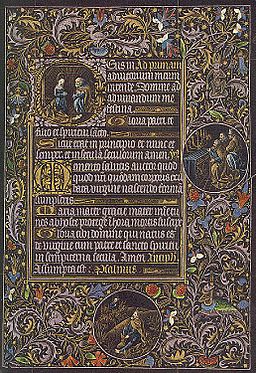
Sforza Black hours - ÖNB Cod1856 f61
Ms 1856, f.61
All of the Black Hours I've looked at appear to be written in silver with one set of notable exceptions, those contained in the Mira Calligraphiae Monumenta [1] housed in the Getty collection. These pages are usually folios of parchment dyed black during the stretching and scraping process.

Since real silver is likely to tarnish [2] I'm using my W&N silver gouache. The calligraphy is done in this same gouache, watered down so that it flows easily from the nib (Mitchell #5). Writing silver on the black paper wasn't as difficult as I had imagined it would be, although it did take almost twice as long as writing in regular ink. The biggest issue was that I needed to continually mix the gouache [3] and clean my nib every few words so that I could keep a fairly consistent and sharp line for the writing. I also had to use a larger nib than I had wanted since I just couldn't achieve crisp lines with my usual #6 nib. As a by-product the entire piece is larger than I had originally wanted it to be.

This project requires A LOT of gold. The few images I have available to me for the Sforza Hours suggest that most of the gold appears to be painted rather than gilded. For the guide-lines and the written gold words I used my Holbein gold gouache since it works in the same fashion as the silver and was just easier. However for the rest of this piece I wanted a more dramatic luminescence than the gouache offers, so I made my own powdered gold out of the 23k sheets I use for gilding (keep an eye out for a follow up instruction post for this!).

Sforza Black hours - ÖNB Cod1856 f32v - four evangelists
Ms 1856, f.32 verso
My next step was the illustration of the Pelican. I chose to use white gouache as I wasn't sure how much workable paint I would actually need and I just don't have that much lead-white here. My biggest challenge was remembering that when working on a dark ground you're essentially painting in reverse, you're painting the highlights and letting the black ground act as the shadows. I do love how this illustration came out, although I'm not sure I've really managed the correct medieval aesthetic. I would say that mine looks "heavy" by comparison, although this could just be the nature of filling the area with a giant white bird.

Just when I was completely sick of working in white I was finally able to switch to the 23k powdered gold I had created specifically for this piece. To accompany my dish of prepared gold pigment, I also have a small dedicated jar which contains distilled water to collect any scraps from my dedicated gold paintbrush. By doing this I'm always cleaning the dedicated brush in clean water and retaining any fragments during the process, these can then again be prepared for use as gold pigment at a later date.

The gold work actually became as annoying as the white work due to the length of time it ended up taking. It didn't go on nearly as smoothly as I hoped that it would, even though my paint was "wet". In hindsight I wonder if it needed he gold grains to be finer by more grinding.

The silver within the borders was done concurrently with the gold so that I would keep the flow looking consistent.

Next came the colours, all of which went on smoothly and easily. In testing I found that my Cadmium Red gave a much nicer colour than the Spectrum Red that I tend to use more often. My guess is that because the Cadmium Red leans towards orange/yellow it played well against the substantial amount of gold. The Ultramarine blue was cut with a little Permanent White as Nataliia had suggested during out time at Pennsic, it makes for a more vibrant colour than the base tube-colour.

Diego has served over many years in three separate Kingdoms which I was asked to represent on this piece, the roundels within the borders made an ideal location for these; from left to right - Ansteorra, Aethelmearc, and the East. The fourth is Sharc, an East Kingdom household of which Diego is a member. His arms are displayed in the decorated initial D.

Sforza Black hours - ÖNB Cod1856 f32verso-33recto Details:
Calligraphy & Illumination by Isabel Chamberlaine.
Inspired by the Black Hours of Galeazzo Maria Sforza as seen to the right.

Paper: Black 120gsm paper (I forget which brand).
Materials: Holbein "Pearl Gold" and Windsor & Newton "Silver" gouaches for layout lines, calligraphy, and select details. 23k powdered gold in a gum arabic binder for the majority of gold-work. Various W&N gouache for any of the coloured areas.

Text by Alys Mackyntoich
We, Gregor, by right of arms King of the East, and Kiena, his Queen, considering the great, long and earnest travails and labours sustained by Diego Miguel Munoz de Castilla in the service of the art of defence and the safe practices of same for some score of years and more, and after due consideration of the cause above-written and other good and thankful service done by the said Diego to our sister realms of Aethelmearc and Ansteorra, do therefore ordain, approve and confirm the elevation of the said Diego to the Order of the Pelican, and do convey therewith all liberties and privileges attendant thereupon. And we do further by these our present letters give, grant and convey to the said Diego the right to bear arms by letters patent in the following form:  Argent, on a bend sable three escallops palewise argent.  And we do further ratify and approve, for ourselves and our successors, that the gifts and grants made herein shall be in all time coming effectual, good, valid and sufficient perpetually in all and sundry points, and do hereby ordain the same to be put to due execution, and to have full force, strength and effect in all time coming.  Given at Iron Bog upon 7 September in the forty-eight year of the Society.


Footnotes:
[1] This was confirmed during a class I happened to take at Pennsic 2013 that presented findings by the Getty that the black hours contained within the Mira Calligraphiae Monumenta were actually created using a resist technique. Although I need to track down the original source from the Getty, the gist of it was that the calligraphy was written with some sort of resist on white paper, it was then washed over in black ink to create the dark page. The resist is then rubbed away to reveal the calligraphy as the white of the page.

[2] I really do need to test out the tarnishing of real silver on the work we do in the SCA. Just how long does silver-leaf take to tarnish?

[3] Both silver and gold gouache need to be regularly mixed since the metallic pigment has a tendency to settle.

Scroll ID: Isabel C XLII
Completed Sept. 5, 2013