Showing posts with label Arts and Sciences. Show all posts

Tuesday, May 29, 2018

Jean Paul Ducasse (Order of the Laurel)

Order of the Laurel
War of the Roses (East Kingdom)
Awarded May 26, 2018  (AS LIII)


Details: Calligraphy & Pen Work by Isabel Chamberlaine. Inspired by "The Permennter" from Hans Sachs "Everyday description of all estates on earth, high and low, spiritual and secular, of all arts, crafts and quarrels" (The Estates Book).

A few years ago (2014), a number of us were persuaded to enter the K&Q Arts & Sciences competition that was being held in our local Barony, Concordia of the Snows. We formed, what became known as, "The Messy Corner"; it was a chance to display unfinished, experimental type pieces. I was roped in by Aife, and I decided that if I was going to do it then I was damn sure I was going to rope JP in as well. Eventually he agreed to set up his parchment making stuff as a display (rather than enter the comp.) and actively work on, and discuss this trade with anyone who was interested. He had a steady stream of people all day asking questions and trying their hand at the scraping. He was a big hit.

We discussed it in depth later. The skin he had displayed was a mess because of the inconsistant methods/process used on it throughout the day; going in, he knew this would be the case though. He basically considered it a "throw away skin". I asked if I could have it.

What he didn't know, I was playing the long-game.

You see, JP has always been convinced that he would NEVER be considered for inclusion in the Order of the Laurel. We spent HOURS discussing the lack of period sources for the production of parchment; how it was "cheating" because he had years of tannery experience; how he sucks at writing documentation; how he could never teach this stuff; I could go on... but eventually, over time, he found his way, turning his knowledge and passion for parchment making into a stream of education for those that were interested.

This same, crappy piece of skin, worked on by so many hands at that K&Q A&S, has been with me ever since; kept safe for this EXACT moment. I (and others) have always known that JP would join the Order of the Laurel, it was inevitable.

The artwork for this piece is specifically created within an 8" x 10" space so that, if JP so chooses, the skin can be cut down to a standard frame size; the realist in me fully expects him to do this. The artist in me hopes that he doesn't.

Paper: THIS SKIN, stretched, displayed, and worked on at K&Q A&S in 2014.
Materials: Mitchel calligraphy nib #4 with homemade Oak Gall ink.

Words by Master Valentyne Shawe.

For scribal friend what fame should we impose?
Jean Paul Ducasse, a man of messy skill,
Who treats a skin and bends it to his will.
But how to treat a man of skins who knows
that using brine of women's passing shows
most white. Then stretching skin on rack until
he wields the knife to scrape it clear, and still
then renders silken smooth with sanding loaves.
Now called by Caoilfhionn Queen and Brennan King.
On Dyfan’s Day, in homeland known for snow,
when clash the flags of roses red and white.
Jean Paul now kneels to hear the nobles sing
in praise of work, while monarchs now bestow,
the Laurel leaves for scholar bold and bright.

Scroll ID: Isabel C 61
Time Invested: About 5 hours
Completed May 5th, 2018

Monday, February 24, 2014

Entering K&Q Arts & Sciences

First the negative. I'm generally not a fan of A&S competitions as I feel that they're far to subjective to the whims of those judging. I also dislike that most entries are focused on dramatic finished pieces, I feel that the craft gets overlooked because they're so mundane. That said, I was talked into entering this K&Q on the premise that a number of us band together to concentrate on the craft components of our individual disciplines rather than the end product. That appealed to me.

The intention had been to display more, but mundane reality took over so that my entry was reduced down to just two pigments, sap green and verdigris. Both were considered important greens to the medieval artist.


My Experience.
I went into this with eyes wide open. It was about display with the aim of discussion rather than competing to win anything. I feel like this was an important distinction for me and helped relieve some of the feeling of obligation that I often get around this type of thing. My entry was based around what I wanted to show and how I wanted to show it, it wasn't complete and I willingly displayed my mistakes and failures, even pointing a few of them out. Documentation was written in a style that suited me and my thought process rather than trying to fit it into a set of arbitrary rules about how long it should be or how it should be formatted. Basically, I did this MY way.

Judge #1: This was a positive but interesting experience. The judge read my single-page synopsis and then semi-speed read my full documentation. I appreciated this as I feel like just as much work goes into writing documentation as the research. We then discussed my entry at some length, talking about what I had on display and how I could (and intend to) push it further. The thing that struck me the most about this experience was the open negotiation over scores, I've never seen this before. It's an interesting approach that I think I might adopt for myself if I find myself being a judge again in the future. I am my own worst critic and I already knew this, but it was interesting to hear someone else's take on my own thoughts in live-time. The only thing I think that I would change about this style of judging would be to later add a comment or two on the score-sheet.

Judge #2: Again, a positive experience and I appreciated my documentation being read in full, with some injected discussion. The comment on the score sheet from this judge was very uplifting and recognized one of my ultimate goals, so it was a little of an ego-boost for me and suggests that I'm heading down the right path for my personal journey.

Judge #3: This judge challenged me but it wasn't in any way negative, questions were asked that made me think. I did feel quite flustered and tongue-tied while talking with this judge as I just couldn't seem to find my words. I should have been able to answer at least one of the questions asked because I know for a fact that I've read the answer during my research. It's a really basic question too. The other question that stuck out was something I know to be true but I don't know WHY I know it's true. Yet. This one will send me down a research path and there will probably be an associated blog-post at some point. I thought this judge would end up being the harshest of my scoring, surprisingly they weren't (not that any of my scores were bad). This judge don't read my documentation, but they did take a copy away with them.


Tuesday, December 17, 2013

Rendering Suet

Purchased beef suet.
Suet is raw beef fat [1] and is generally considered a waste product of the commercial meat industry. In hindsight I would have preferred to use pasture-fed, organic suet so that I can use it for creams and soaps, however since the original plan was to just use it for candles I'm starting with two packages of beef suet purchased from the local supermarket - 2.90lb for $1.69/lb. Next time I will be a more discerning shopper.

First, chop the suet into small chunks, the smaller the chunks the easier it will process (if you have a meat grinder available then use it). Raw suet feels greasy to the touch just like you imagine fat to feel. Discard anything that looks like muscle, tendon, bone etc.

Almost 3lbs of chopped beef suet.


Simmering on the stove.
Liquid after filtering.
 Put the suet chunks in a large pot and just enough water to cover it. Bring it to a boil CAREFULLY, making sure that it doesn't boil over as it will smoke, set off the fire alarm and potentially cause a fire [2]. If it does overflow it's disgusting, clean up any mess immediately.

As soon as it starts to boil turn the heat down to a low simmer. I left mine like this for about three hours mashing the solids every so often to release the fat [3].

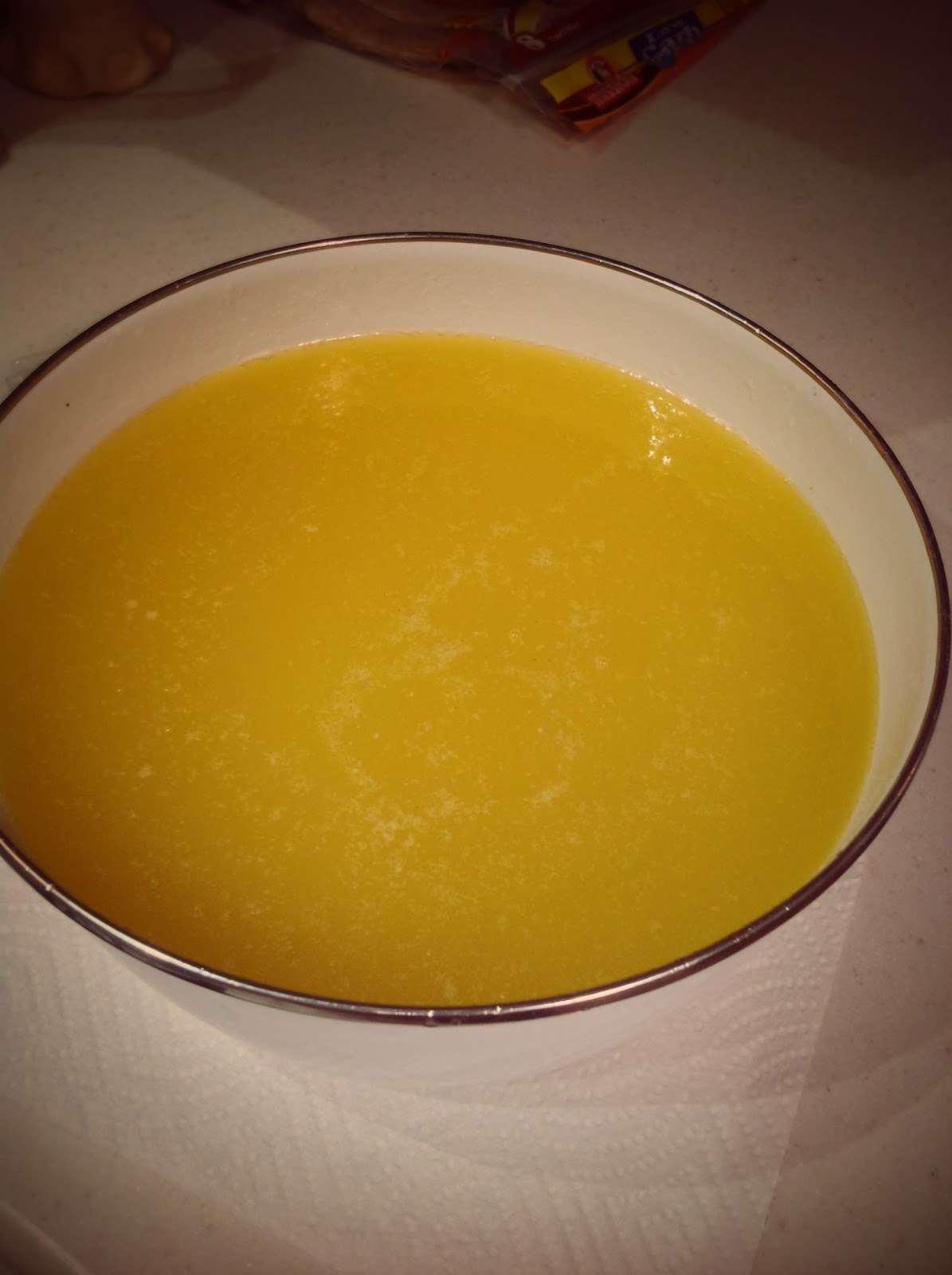
When you decide that it's finished cooking, carefully pour the fatty water through a sieve into a clean bowl and squish the juices out of the fat solids (in the sieve) as best you can. You'll be amazed at how much liquid these retain. Let the bowl of "juice" cool until the top is a solid, creamy-white mass. I put mine in the fridge overnight.

Tallow after being
chopped for final cooking.
Use a knife around the outside to separate the mass of fat from the sides of the bowl, but be careful not to slop the liquid underneath. Lift it out and rinse it in cold water to get the scummys off, I used a knife to gently scrape them away. I weighed mine and it came in at 2.11lbs (down from starting at 2.90lbs. At this point some say to do a second simmering, however I chose to follow instructions that just went straight to chopping it up and putting it into a double-boiler set-up. Melt it down and let it boil off any remaining water. Mine sat on the stove for about two hours.

Strain it through a fine sieve to remove any remaining scummies. I used a piece of natural linen in my metal sieve. At this point you can strain it straight into your final storage container, it will harden to a creamy-white mass. Mine has the slightest hint of a beef smell when you stick your nose right up to it.
Finished tallow that will be used to make candles for the production of lamp-black pigment.


Citations:
[1] Mirriam-Webster Online defines suet as "the hard fat about the kidneys and loins in beef and mutton that yields tallow".
[2] My "Shop Gnome" and I were having a discussion when he convinced me (stupidly) to continue it in the garage since the pot was nowhere near boiling. Not three minutes later I hear the sizzle of the fatty water hitting the stove-top and open the door to discover smoke billowing from the kitchen just as the fire alarm started to warn us of the danger. It was a HUGE disgusting mess of fat covering everything and took a decent amount of time to clean up before I could put the pot back on the stove.
[3] I've since read accounts of others leaving it to simmer for up to eight hours. Some using the stove, others using the low-setting on the crockpot.

Sources:
http://thehoodedhare.com/lighting-in-the-middle-ages.pdf

http://www.candles.org/about_history.html

http://en.wikipedia.org/wiki/History_of_candle_making

http://lostartskitchen.wordpress.com/2011/03/12/rendering-fats-at-home-primer-lesson-one/

http://preparednessadvice.com/food_storage/suet-and-tallow/#.Uqz1HSG9KK0

Monday, April 29, 2013

Recommendations for Beginner Scribal Materials

Does this sound like you...

"Mostly I don't know where to start. I like to look at all of the pretty scrolls but I don't know what basic supplies to get to start trying."

It certainly sounded like me when I first started, and even though I have an art background I had no clue how to get started or what supplies I needed. I spoke with a few people, found a few online scribal communities, joined some email lists, and asked a few questions. There was however a lot of trial and error and although I've gained confidence and skill I still remember those first tentative steps, so here are my recommendations for beginners on the types of tools and materials to equip themselves with.

Firstly, buy the tools and materials that YOUR budget will allow. Also, remember that materials (and by extension your art) end up being very personal, so what one artist loves another one dislikes. These recommendations are just MY opinion, try different tools and materials as your time and budget permit - if you love them, great. If not, then try something else until you find something you do like.

Strathmore 300 Series Bristol Board - In reality it's just thick, multi-medium paper and comes in a smooth  or textured finish. The smoother finishes are much nicer for calligraphy. It can usually be found in local arts and crafts stores, various online stores also carry it. Look for “acid-free” paper to prevent degradation over time. I have both a 9 x 12 and an 11 x 14 pad, one in the "smooth" finish and the other in the "vellum" finish. Both have successfully been used to complete scribal assignments.

Artist Paint Brushes - You'll want to build a selection of small, "round" brushes that have a point. Look for brushes that have at least one "0", preferably multiple "0000" or "3/0" - that's their size. Synthetic hair is fine, and cheaper. "Gold Scepter" is a brand that springs to mind that is readily available in the smallest sizes and perform very well.

Artists Goauche - I am a fan of the Windsor & Newton goauche ("artist" or "designer", rather than "student" grade). However there are other brands, for example I hate the W&N gold but I LOVE the Holbein brand counterpart (Pearl Gold - G641). I will say that if you're going to splurge on anything, gouache should be that thing and as a very general rule, the more expensive the tube the higher the pigment concentration. You can usually buy basic colour sets, or you can buy individual tubes of the colours you need. Try to stick to one manufacturer as much as possible so that the ingredients don’t “fight” over time. When I first started, I just bought individual tubes as I needed them and initially found the following W&N colours to be the most useful - "Ultramarine", "Brilliant Yellow", "Cadmium Red", "Permanent White" and "Jet Black"

Personally I find the "student grade" paints chalky so they end up looking pale or weird on the page. This is a personal gripe I have from my college days though, others may disagree with me.


Pens for Calligraphy - You can usually buy basic calligraphy nibs and holders in sets at the art store. Speedball brand is probably what you will find and they do the job just fine. Each set will have a variety of nib sizes to create different size letters, but make sure at least one of the nibs comes to a fine-point so that you can use it for drawing the lines for your art work.

Ink for Calligraphy - Art stores will usually carry a large selection of inks in various colours. Sometimes, you'll get lucky and find "Iron Gall Ink" or "Oak Gall Ink". If your store carries either of these then buy it and take pride in the fact that you have your first (depending on the recipe and production) period artist material. Iron Gall Ink is my default and I very rarely use anything else because I love the way it flows from my nibs.

Now, I haven't personally seen Iron / Oak Gall Ink sold in any of the stores I've been in (I buy it online), therefore my other beginner recommendation for dip-pens is Sumi black ink. It comes in a bright green, heavy plastic bottle with a black cap and the ink itself has a nice viscosity to it. A word of warning though, it is very corrosive on your nibs if you don't clean them properly. It's very black, and works really well for line-work. You can also find this ink in red (red bottle, black cap).

Pencil - Used for sketching out your artwork and drawing your calligraphy guidelines. When you're at the art store you'll notice that they are graded, "B's" with a higher number being the softest through "HB" which is the middle and then into "H's" which are considered hard. You're looking for a grade that won't damage the surface you'll be working on and that can be erased easily.

Personally I opt for a 2H as it works FOR ME, but choose a grade that will work for the type of pressure you're likely to apply while using it. To hard and it will damage your surface, to soft and you'll have a tougher time while erasing.

Rubber / Eraser - Many scribes swear by those blocky, hard rubbers you probably used in school, just make sure that it's white to avoid potentially marking the page. These can be purchased in a variety of places.

I personally find those hard white rubbers a little weird to use and dislike them. I tend to use what is known as a "putty rubber" or "kneadable eraser" as it works better for me. These are usually found near the pencil selection in the art store.

Straight Edge - You'll need some sort of ruler to mark out your page and draw the lines you'll need for calligraphy. Rulers can be purchased in a variety of materials, lengths and styles. Personally I recommend that you buy one made out of metal as plastic and wooden rulers have the potential of being sliced by your craft knife, thus ruining the straight edge. If you can find one that has a cork backing even better, as this raises the edge off the page a little and helps avoid bleeding or smudging.

Paint Palette - Cheap, multi-well plastic palettes can be found at arts and crafts stores. However, you could also use a dinner plate, ceramic tiles, muscle (or other crustacean) shells, a glass ashtray or any other number of household items you probably already own.


Other Random Supplies - Although you don't NEED any of the following supplies they're useful to have around.
  • Distilled Water - I tend to use this rather than regular tap water to avoid the various additives combined at the treatment plants. One argument is that because it's "purer" it's closer to period water, but who knows if this is true or even really matters.
  • Eye-dropper / Pipette - Found at pharmacies, they end up being very useful for adding very small amounts of water to your paints to thin them.
  • Scalpel / Craft Knife - If you're buying the pads of Bristol paper you probably won't need a craft knife as they're already sized appropriately. However they useful to have around.
  • Cotton Ear-Buds - Yes, the things you clean your ears with. They're actually very useful dipped in rubbing alcohol to clean your calligraphy nibs.
  • Rubbing Alcohol - As mentioned above, rubbing alcohol is great for cleaning your calligraphy nibs.
  • Magnifier - Helps you not strain your eyes! 
  • 100% Talc - Wash your hands, dry them and then coat them in talc. It's stop your hands from sweating while you work.
  • Scrap Paper - Rest your hand on some scrap paper while you work as it will protect the page you're working on from getting greasy and picking up smudges. Hands are dirty!
Useful Links - There are numerous online resources for the things I have mentioned in this post, below are a few of the websites I find useful. Remember to check your local arts and crafts stores as many of these items can be found there.